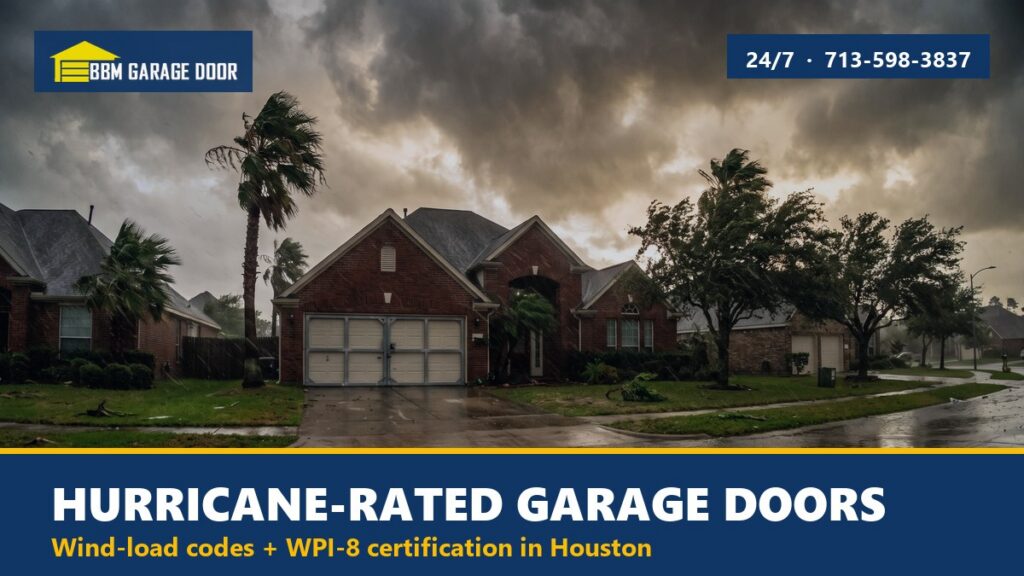
Hurricane-rated garage doors — also called wind-load rated or windstorm certified doors — are doors engineered and tested to resist specific wind pressures, both pushing in and pulling out. In greater Houston, whether the code requires one depends on your address. Homes in Galveston, Chambers, and Brazoria counties, and in parts of eastern Harris County, sit inside Texas Department of Insurance (TDI) designated catastrophe areas, where a certified wind-rated door is tied directly to your windstorm insurance eligibility. The rest of Houston has no TDI mandate, but the wind doesn’t check county lines. It’s September — the peak of Atlantic hurricane season — and your garage door is the largest, and usually weakest, opening on your home. Here’s what we tell our own customers.
Why the Garage Door Is the First Thing a Hurricane Tests
A double garage door can be a 112-square-foot sail bolted to light steel tracks. Wind loads it two ways: positive pressure pushes it inward, and suction on the leeward side pulls it out of the opening. That’s why real wind ratings always list two numbers — a positive and a negative design pressure.
The bigger danger isn’t the door itself. The U.S. Department of Energy’s Building America program puts it plainly: once a garage door fails, strong winds enter the building and raise internal pressure until it can push out windows, walls, doors, and the roof, causing building failure. The house inflates like a balloon, and the roof is the first thing to let go.
Houstonians who were here for Hurricane Ike remember how many garages gave way before anything else did. A failed door turns a survivable storm into a gutted house.
Texas Windstorm Code: Harris vs. Galveston vs. the Coastal Counties
TDI runs the state’s windstorm inspection program, and it applies only in designated catastrophe areas: fourteen coastal counties — including Galveston, Chambers, Brazoria, and Matagorda — plus a slice of Harris County east of State Highway 146 inside the city limits of La Porte, Morgan’s Point, Pasadena, Seabrook, and Shoreacres.
Design wind speeds step up as you approach the water. Under the older TDI building code, the inland-most zone was designed for a 110-mph three-second gust, the middle zone for 120 mph, and the seaward zone for 130 mph; the eligible portion of Harris County was set at 120 mph. TDI has since moved to the risk-based maps in the ASCE 7 standard, which express roughly the same strength requirements as “ultimate” design wind speeds — generally in the 130–150 mph range along our stretch of coast, determined address by address. And as of April 1, 2026, new windstorm certification applications must comply with the 2024 International Residential Code or International Building Code.
In practice: if you live in League City, Kemah, Dickinson, Texas City, or Galveston, windstorm rules apply to your whole county. In Seabrook or La Porte east of Highway 146, they apply to you too. In Meyerland, Bellaire, or the Heights, TDI’s program doesn’t reach you — but your home still faces hurricane winds, and a pressure-rated door is one of the highest-value upgrades you can make.
WPI-8 Certification: Why the Paperwork Matters as Much as the Door
In a designated catastrophe area, replacing a garage door counts as an alteration to the structure — the same as replacing a roof — and it must be certified. A TDI-appointed engineer inspects the work, and the state issues a WPI-8 Certificate of Compliance (or a WPI-8-E for improvements certified after completion, a path TDI has handled since June 2020).
That certificate is your ticket to coverage through the Texas Windstorm Insurance Association (TWIA), which writes the wind and hail policies most coastal carriers won’t. Per TWIA, uncertified alterations — garage doors are specifically on the list — can jeopardize your eligibility. Some older homes built between 1988 and mid-2009 can still qualify without certificates, but at a 15% premium surcharge. Skipping the paperwork on a new door can quietly cost you far more than the door itself.
Certification also depends on the product: TDI maintains a database of approved, tested door assemblies, and doors must be tested to standards such as ASTM E330. An approved door installed to the manufacturer’s windstorm specifications, then inspected — that’s the full chain. Break any link and there’s no certificate.
How to Tell If Your Existing Door Is Wind-Rated
Open the door partway and look at the inside face of the panels, typically on an end section. A wind-rated door carries a permanent label listing the manufacturer, model or series number, the positive and negative design pressure rating, and the test standard it passed.
Two things trip people up. First, ratings are stated in pounds per square foot (psf) of pressure, not miles per hour — many labels show no wind speed at all, because the required pressure depends on your home’s height, exposure, and location. Second, no label almost always means no rating. Builder-grade doors installed before local codes tightened were simply never tested.
Also look past the door itself. The Door & Access Systems Manufacturers Association (DASMA) stresses that the attachment of the track and the jamb to the structure is just as critical as the strength of the door. A rated door screwed into rotted or under-fastened framing — common in Houston’s humidity — won’t perform to its label.
Retrofit Bracing Kits vs. Full Replacement: An Honest Comparison
Retrofit kits add vertical posts or horizontal struts to stiffen an existing door. They’re real products with a real place — and real limits:
| Retrofit bracing/strut kit | Wind-rated replacement door | |
|---|---|---|
| Typical cost | Roughly $150–$500 in parts for a double door, plus professional installation | Roughly $1,100–$6,750 for a rated steel door before labor (industry ranges) |
| Wind protection | Meaningfully stiffer, but performance is unverified for your specific door | Lab-tested to published positive and negative design pressures |
| TDI/WPI-8 certification | Generally no — bracing a standard door does not make it an approved, tested assembly | Yes, when an approved door is installed to spec and inspected |
| Side effects | Added weight can throw off spring balance and strain tracks | New springs, tracks, and hardware engineered as one system |
DASMA’s guidance is blunt: owners should not add non-manufacturer-specified reinforcement themselves, because the extra weight can collapse tracks or components never sized for it, and reinforcement often requires a matched package of springs, hardware, and track installed by a trained door technician.
FEMA’s wind retrofit guidance (P-804) points to two reliable paths: install a certified wind-rated door, or protect the entire door with a tested impact-resistant covering. If you’re inside a catastrophe area and want the insurance benefit, replacement with an approved door is the option that actually produces a certificate. Outside the windstorm zone, a professionally installed bracing kit on a sound door can be a reasonable budget stopgap — as long as you understand it’s a stopgap.
What Wind-Rated Doors Cost Compared to Standard Doors
National cost guides put wind-rated doors at roughly $900–$4,700 for vinyl, $1,100–$6,750 for steel, and $1,400–$6,800 for fiberglass before labor, with installed projects ranging from about $1,450 to $12,000 depending on size, material, and design. Installation labor typically runs $275–$400 for a single door and $415–$800 for a double. Impact-rated doors with tested glazing generally cost 30–50% more than wind-rated doors without it.
The premium over a comparable standard door buys heavier-gauge steel, more struts, reinforced hinges and brackets, and beefier track — plus, in windstorm zones, the engineering paper trail. For a full breakdown of what standard doors run in our market, see our guide to garage door costs in Houston for 2026. We give free written estimates on both, so you can compare real numbers instead of national averages.
It’s Peak Season — Here’s How to Time This Honestly
Early September is the statistical height of the Atlantic hurricane season, and we won’t pretend otherwise: the ideal time to upgrade was May. But the season runs through November 30, and wind-rated doors are frequently special-order items. Once a storm gets a name in the Gulf, every supplier and installer in the region gets slammed at once. Ordering on a clear week in September beats scrambling on a watch-and-warning weekend in October.
Our team handles overhead garage door installation across the metro from our Southwest Houston shop on Imogene Street and our Clear Lake location on Space Park Drive — right in the middle of the communities where windstorm certification matters most. And if a storm beats you to it, our 24/7 emergency garage door repair crews work around the clock to get a failed or storm-damaged door secured.
Frequently Asked Questions
Do I need a hurricane-rated garage door in Houston?
Legally, it depends on your address. In the designated coastal counties — plus the part of Harris County east of Highway 146 in the five cities named above — a replacement door should be an approved wind-rated assembly, certified for insurance purposes. Elsewhere in Houston it’s optional, but it’s the opening most likely to fail in a hurricane.
Will a bracing kit satisfy Texas windstorm requirements?
Generally, no. TDI certification is based on tested, approved door assemblies installed to the manufacturer’s specifications and then inspected. An aftermarket brace on a standard door doesn’t turn it into an approved assembly, so it won’t produce a WPI-8 certificate — even if it does make the door somewhat stronger.
How do I find out what pressure rating my new door needs?
Required design pressures depend on your location, exposure, door size, and building height — TDI now points to the ASCE 7 hazard maps, applied address by address. Our technicians work from those requirements and TDI’s approved-product listings when quoting doors in windstorm areas, so the door you buy is one that can actually pass inspection.
Do wind-rated doors look different from regular doors?
Not from the street. The reinforcement — heavier gauge panels, extra struts, upgraded hardware — is on the inside. Major manufacturers offer wind-load versions of most standard panel and carriage-house styles.
What should I do with my garage door when a hurricane is coming?
Close it, lock it, and leave it closed — DASMA warns against operating a garage door during high winds, and an open door exposes your walls, ceiling, and roof structure to damage. Don’t park a vehicle against it for “support,” and don’t bolt on improvised bracing the springs and tracks were never sized to carry.
If you’re not sure what’s guarding the biggest opening in your house, let’s find out before the next cone of uncertainty shows up. Call BBM Garage Door at 713-598-3837 for a free estimate — we’ll check your current door’s rating label, tell you straight whether bracing, replacement, or nothing at all is the right move, and walk you through the windstorm paperwork if your address requires it.