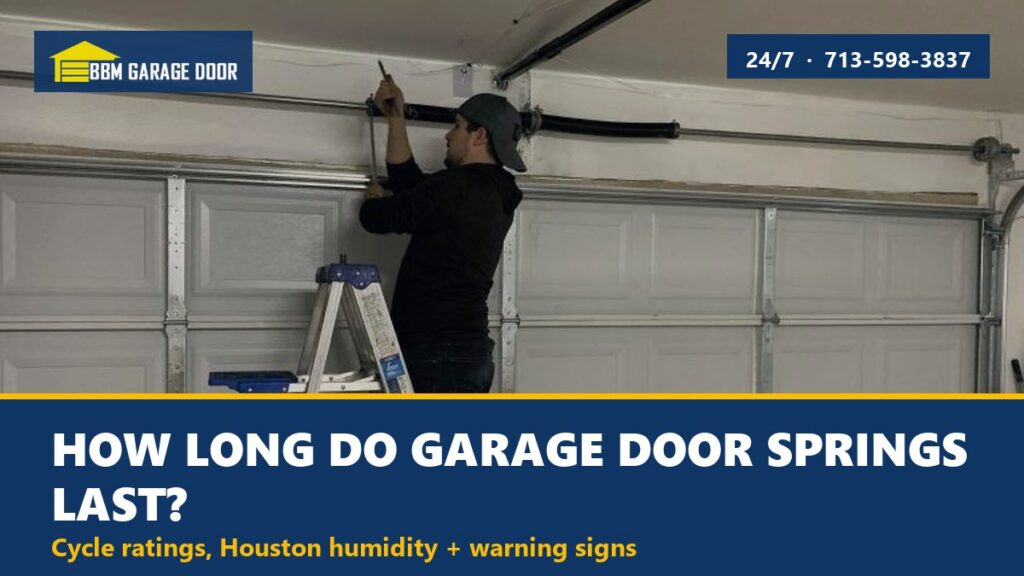
Most garage door springs are rated for about 10,000 open-and-close cycles. For a typical Houston household that uses the door four times a day, that works out to roughly seven years of service, and lighter use can stretch it to ten or more. But those ratings assume ideal conditions, and the Gulf Coast is anything but ideal for steel under tension. Between our year-round humidity and the salt air that drifts in off Galveston Bay, our technicians regularly replace springs that gave out well before the calendar said they should.
Here is how spring life is really measured, how to run the math for your own household, why Houston’s climate is so hard on springs, and the warning signs that yours is on the way out.
Spring Life Is Measured in Cycles, Not Years
A garage door spring does not wear out on a schedule. It wears out with use, which is why manufacturers rate springs in cycles rather than years. One cycle is one full trip: the door goes up once and comes down once.
The industry-standard torsion spring — the tightly wound spring mounted on a shaft above the door — is built to deliver about 10,000 cycles. Torsion springs do the heavy lifting on most modern Houston garage doors, twisting and untwisting to counterbalance a door that can weigh a couple hundred pounds.
Extension springs are the older style: long, stretchy springs that run along the horizontal tracks on each side of the door. They are common on older homes and budget installations, and they generally do not last as long. Typical extension springs are rated in the range of 5,000 to 10,000 cycles, and because they stretch and contract with every cycle, they tend to fatigue faster than torsion springs carrying the same door.
The Daily-Use Math: How Many Years Is 10,000 Cycles?
Once you know the cycle rating, the math is simple: divide it by your daily ups-and-downs times 365. Here is how it shakes out for common ratings:
| Spring rating | 2 cycles/day | 4 cycles/day | 8 cycles/day |
|---|---|---|---|
| 10,000 cycles (standard) | ~13.5 years | ~7 years | ~3.5 years |
| 25,000 cycles (high-cycle) | ~34 years | ~17 years | ~8.5 years |
| 50,000 cycles (commercial-grade) | ~68 years | ~34 years | ~17 years |
These are theoretical maximums, before Houston’s climate takes its cut. And be honest about your count: two working adults, teenage drivers, and a garage that doubles as the main entry can easily push a door to eight or more cycles a day — enough to wear out a standard spring in under four years.
Why Houston Springs Often Die Young
Houston sits in a humid subtropical climate, and our average relative humidity holds in the mid-70-percent range essentially year-round. That moisture matters because a garage door spring is bare, high-carbon steel that lives in an unconditioned space. Warm, damp Gulf air moving through a garage condenses on cool metal, and over the years that constant film of moisture feeds surface rust.
Rust is more than cosmetic on a spring. Corrosion pits the steel and creates weak points, and every one of those thousands of cycles flexes the spring right across those pits. A corroded spring can snap well short of its rated cycle count, which is why a “10,000-cycle” spring in a Meyerland or Sharpstown garage often fails years earlier than the same spring would in a dry inland city.
Closer to the water, it gets tougher still. In Clear Lake, Nassau Bay, Seabrook, Kemah, and League City, homes catch salt-laden air off Galveston Bay and the Gulf. Salt acts as an electrolyte that speeds up oxidation on steel, and garage door companies in coastal markets consistently see springs and hardware fail two to three years sooner than in inland neighborhoods. Our Clear Lake team sees the difference every week: coils with visible pitting on doors that are barely five years old.
One simple habit fights back: a light coat of garage-door-rated spring lubricant a couple of times a year slows the rust that our humidity works so hard to create. It will not make a worn spring young again, but it helps a healthy one reach more of its rated life.
High-Cycle Springs: Buying More Years Up Front
If you are tired of replacing springs, you do not have to settle for the standard rating. Springs are available well beyond 10,000 cycles:
- Standard oil-tempered springs are drawn from high-carbon steel and oil-tempered for resilience, meeting the roughly 10,000-cycle industry standard.
- High-cycle springs are commonly rated at 25,000 cycles or more. They deliver the same lifting torque as a standard spring but use more steel wire, so each coil carries less stress on every cycle.
- Commercial and extended-life springs run 50,000 cycles and up, with some extended-life spring systems rated as high as 80,000 cycles.
For busy Houston households — especially homes where the garage door is the front door — a high-cycle upgrade often makes sense at replacement time. You are already paying for the service call, and the heavier spring can multiply the working life of the repair. That extra margin of steel is worth even more in the bayfront corridor, where corrosion never lets up.
Warning Signs of a Dying Spring
Springs rarely fail without notice. Watch and listen for these signals:
- A loud bang from the garage. A torsion spring letting go under full tension sounds like a firecracker or something heavy hitting the floor. If you heard it, do not run the door — go look at the spring.
- A visible gap in the coil. A broken torsion spring separates, leaving an obvious gap of an inch or two in the middle of the coil.
- The door feels heavy or the opener strains. Springs, not the opener, do the lifting. When they lose tension, the motor labors, the door rises slowly, or it stops a few inches up and reverses.
- The door hangs crooked or moves unevenly. On two-spring doors, one weak side pulls the door out of level.
- Heavy rust or stretched, saggy coils. In our climate, visible corrosion on the coils is an early retirement notice, and extension springs that hang loose or look pulled apart are past due.
- Slack or frayed cables. Cable trouble often points back to a spring problem, and frayed cables are a hazard in their own right.
If you spot any of these, stop using the door. Forcing an opener to drag a door with a dead spring can burn out the motor, bend panels, or drop the door unexpectedly.
Why You Should Never DIY a Spring Swap
We are straight with our customers about most maintenance — homeowners can lubricate hinges, test the safety reverse, and keep tracks clean. Springs are the exception, full stop. DASMA, the door industry’s national trade association, puts it plainly: spring systems are dangerous and should be repaired only by trained professionals.
A wound torsion spring stores enormous energy — it is what holds up the full weight of your door. Winding or unwinding one takes the right bars, the right technique, and the experience to know when a cone or coil is about to let go. Getting it wrong sends steel moving faster than you can react; crushed hands, facial injuries, and broken wrists are the common results. Sizing is a trap too, since a replacement must match your door’s weight, not just the old spring’s dimensions. And extension systems need safety cables through each spring so a broken one cannot whip across the garage.
This is exactly why our garage door spring repair service runs 24/7 across Houston and Clear Lake. A professional swap takes our technicians about an hour, the new springs are matched and balanced to your door, and nobody in your family gets anywhere near a loaded coil.
Replace One Spring or Both?
If your door has two springs and only one broke, replace both. That is not upselling — it is DASMA’s own guidance, and the logic is simple: both springs have cycled the exact same number of times. The survivor is standing at the same finish line as the one that just snapped, and pairing it with a fresh spring leaves the door unbalanced and puts extra strain on the new spring and the opener.
Replacing the pair in one visit also means one service call instead of two a few months apart. For a full breakdown of what Houston homeowners typically pay for parts, labor, and high-cycle upgrades, see our Houston garage door spring repair cost guide.
Frequently Asked Questions
How often should garage door springs be replaced?
Plan on replacing standard springs every 7 to 10 years with average use, or sooner if your door cycles heavily or shows warning signs like rust, sagging, or a straining opener. High-cycle springs can double or triple that interval. In Houston’s humidity, an annual visual check of the coils is worth the two minutes it takes.
Can I still use my garage door with a broken spring?
No. The spring carries the door’s weight, and without it your opener is lifting far more than it was built for. Running the door can wreck the opener, bend the top panel, or let the door slam down. Leave it closed and call a technician.
Do garage door springs wear out faster in Houston?
Often, yes. Our humid subtropical air keeps bare steel springs damp in unconditioned garages, and rust-pitted springs can break before reaching their rated cycles. Homes near Galveston Bay — Clear Lake, Seabrook, Kemah, League City — face added salt-air corrosion that commonly shortens spring and hardware life by a few years compared to inland areas.
Will lubricating my springs make them last longer?
It helps. A light application of a garage-door-rated lubricant on the spring coils a couple of times a year slows the surface rust that Gulf Coast humidity causes. It is one of the few spring-related tasks that is safe for homeowners, since it requires no contact with a wound spring’s tension.
Are high-cycle springs worth the extra cost?
For most busy households, yes. Since you are already paying for the service visit, upgrading from 10,000 to 25,000 cycles or more adds modest parts cost while multiplying the spring’s working life — a strong value if your garage door is your family’s main entrance.
Wondering how much life is left in your springs? Our technicians serve all of greater Houston from our Southwest Houston shop on Imogene Street and our Clear Lake location on Space Park Drive, 24 hours a day, 7 days a week. Call us at 713-598-3837 (or 281-800-5387 in the Clear Lake area) for a free estimate — we will inspect your springs, tell you honestly whether they have years left or are running on borrowed time, and give you a straight price before any work begins.