
A garage door opener does its job quietly for years, then starts acting up right when you need it most. Most Houston homeowners don’t think about the opener until it hesitates on a hot August afternoon or refuses to close during a storm. The question we hear most often is simple: “Can you fix it, or do I need a new one?”
Sometimes a quick repair is the right call. But there is a point where repairing an old opener is throwing money at a unit that is already past its useful life. Here are the seven signs our technicians look for when deciding whether an opener should be repaired or replaced.
1. The opener is 10 to 15 years old (or older)
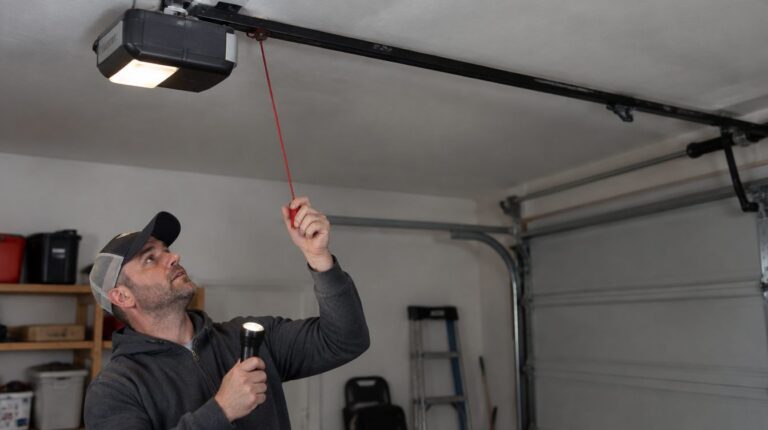
Age is the first thing we check. Most residential garage door openers last roughly 10 to 15 years, and Houston’s heat and humidity tend to push units toward the shorter end of that range. Motors, capacitors, gear assemblies and logic boards all degrade faster when the garage is sitting at 100°F half the year.
If your opener was installed when you bought the house and you’ve been there more than a decade, it’s worth looking at the label on the motor housing. The manufacture date is usually printed there. A unit from the early 2010s may still work, but it is operating on borrowed time, and replacement parts for discontinued models get harder to find every year.
2. No safety reversal or photo eyes
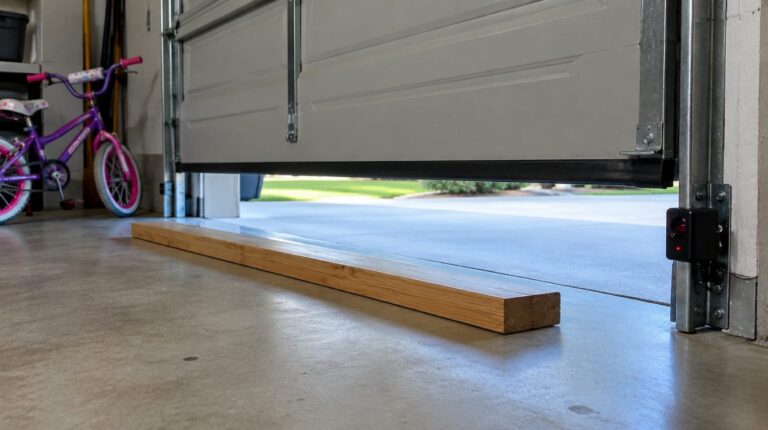
This one is a safety issue, not a convenience issue. Since 1993, federal rules have required garage door openers to include an automatic reversal system, which is why modern openers have the small photo-eye sensors mounted a few inches off the floor on each side of the door. If something breaks the beam, the door stops and reverses.
If your opener has no photo eyes at all, it predates that requirement and should be replaced regardless of how well it runs. A door that doesn’t reverse on contact can seriously injure a child or pet. We recommend testing the reversal on any opener by placing a 2×4 flat on the floor under the door and closing it. If the door doesn’t reverse when it hits the board, call us.
3. It’s gotten noticeably louder
Older chain-drive openers were never quiet, but a sudden change in noise level means something. Grinding usually points to worn gears in the motor head. Loud rattling can be a loose chain, worn rollers or a failing trolley. A humming sound with no movement often means the motor is trying to run but the capacitor or gear assembly has failed.
Some of these are fixable. A gear and sprocket kit on a mid-age opener is a reasonable repair. But if a unit is already old and loud, replacing it with a belt-drive or direct-drive model will cut noise dramatically, which matters a lot if there’s a bedroom above the garage.
4. It works sometimes, but not always
Intermittent operation is one of the most frustrating problems to live with. You press the button, nothing happens. You press it again, the door opens. Tomorrow it’s fine. Next week it’s stuck again.
The most common causes we find:
- A failing logic board (very common in units over 10 years old, especially after Houston power surges and lightning storms)
- Worn or corroded wiring between the wall button and the motor head
- A remote with a dying battery or a receiver losing its programming
- Photo eyes that are slightly misaligned and only catch the beam at certain angles
The remote and sensor issues are cheap fixes. A logic board replacement on an old unit, however, often costs enough that putting that money toward a new opener makes more sense.
5. It doesn’t use rolling-code technology
If your remote uses a row of tiny DIP switches to set the code, your opener is using fixed-code technology from the 1980s and early 1990s. Those codes can be captured and duplicated by a cheap device, which is a real security gap for a door that leads straight into your home.
Every major opener made since the late 1990s uses rolling-code technology, which changes the access code every time the remote is pressed. Modern units also support smartphone control, so you can check whether the door is closed from anywhere, which Houston homeowners tell us is one of the features they end up using most.
6. You’ve paid for repairs more than once in the last two years
Here’s a simple rule we share with customers: if a repair would cost more than about half the price of a new opener, or if this is the second or third repair in a short period, replace it. An opener that needs a new capacitor this year, a gear kit next year and a logic board the year after is costing you more in service calls than a new unit would have.
For context, in Houston in 2026, a professionally installed new opener typically runs from around $450 to $900 for a quality chain or belt drive, with premium wall-mount and battery-backup models running higher. Most individual repairs on an older opener land between $150 and $350. Two or three of those, and you’ve bought a new opener without getting one.
7. The door struggles or strains to lift
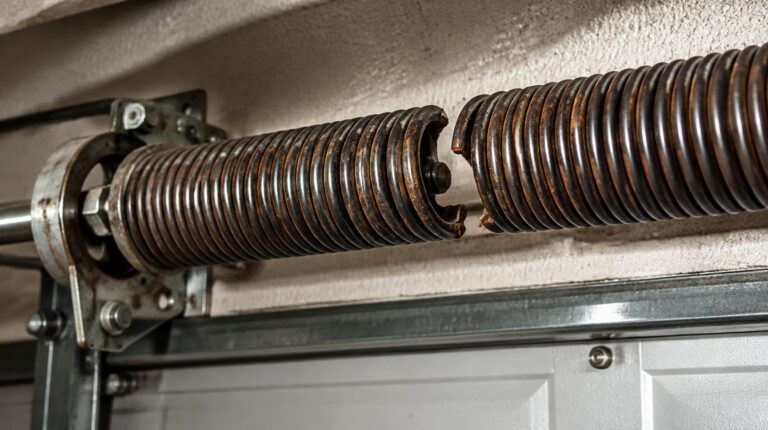
If the opener groans, slows down mid-travel or stops short, don’t assume the opener is the only problem. The opener is only designed to guide a balanced door, not lift its full weight. A worn torsion spring makes the door heavy, which overloads the motor and burns it out early.
Before replacing an opener for this reason, we always check the door balance by pulling the manual release and lifting the door by hand. If it’s heavy or won’t stay halfway, the spring is the issue, and a new opener alone won’t fix it. This is why a proper diagnosis before any replacement matters.
Not sure whether yours is a repair or a replacement? We’ll tell you honestly. Call 713-598-3837 (Houston) or 281-800-5387 (Clear Lake), or request a free quote.
Frequently asked questions
How long does it take to replace a garage door opener?
A straightforward replacement usually takes two to three hours, including removing the old unit, installing the new rail and motor, programming remotes and testing the safety reversal. Same-day replacement is available across most of our Houston service area.
Can I keep my existing rail and just replace the motor?
Occasionally, if the brand and model are compatible, but in most cases the rail, trolley and motor are sold as a matched system. Mixing old and new components tends to cause alignment problems, so we generally recommend a complete unit.
Is a belt drive worth the extra cost over a chain drive?
If the garage is attached to living space or there’s a room above it, yes. Belt drives are significantly quieter and need less maintenance. For a detached garage, a chain drive is still a solid, budget-friendly choice.
Will a new opener work with my old door?
Almost always, as long as the door is in good condition and properly balanced. We check the springs, cables and track during installation so the new opener isn’t fighting a door problem from day one.
Related guides
- Garage Door Opener Repair & Replacement Cost
- LiftMaster vs Chamberlain vs Genie
- Smart Garage Door Hub
Get same-day garage door opener service in Houston
BBM Garage Doors repairs and replaces all major opener brands across Houston, Katy, Cypress, Spring, The Woodlands, Pearland, Sugar Land, League City, Clear Lake and surrounding areas. We’ll diagnose the real problem, give you a clear price before any work starts and get your door running the same day. Call 713-598-3837 (Houston) or 281-800-5387 (Clear Lake), or learn more about our garage door repair services.