
A garage door that won’t move is frustrating, but a surprising number of “broken” doors turn out to be a dead remote battery, a bumped sensor, or a lock button somebody pressed by accident. Before you call anyone, there’s a short list of checks that are completely safe to do yourself and take about ten minutes.
This guide walks through those checks in order, then ends with a clear list of things you should never try to fix yourself. Garage doors are heavy and the springs are under serious tension, so knowing where the line is matters.
Step 1: Confirm the opener has power
Start with the obvious. Look up at the opener motor unit. Is the light on, or does it come on when you press the wall button?
- Check that the opener is plugged into the ceiling outlet. Vibration can work a plug loose over time.
- Check the breaker panel for a tripped breaker. Garage circuits often share a GFCI outlet; press the reset button on any GFCI outlet in the garage.
- If a storm just came through, a power surge may have knocked the opener offline. Unplug it for 30 seconds and plug it back in.
Houston storms knock out plenty of openers; our guide on what to do after a power outage covers the next steps.
Step 2: Test the remote vs. the wall button
This single check tells you a lot:
- Wall button works, remote doesn’t: almost always a remote battery. Replace it and try again. If that doesn’t fix it, the remote may need to be reprogrammed; see our guide on programming LiftMaster remotes and Genie keypads.
- Neither works, but the opener light is on: check lock mode below, then move on to Step 3 (photo eyes).
Also check for lock or vacation mode. Most wall consoles have a lock button, often marked with a padlock icon. When it’s active, remotes and keypads are disabled but the wall button still works, and it gets pressed by accident more often than you’d think. If the opener light is blinking steadily or the console shows a lock indicator, press and hold the lock button for a few seconds to turn it off, then try the remote again.
Step 3: Inspect the photo-eye sensors
If the door opens fine but won’t close, or starts to close and then reverses while the opener light flashes, the photo eyes are the usual cause. These are the small sensors about six inches off the floor on both sides of the opening.
- Look at the indicator lights on each sensor. Both should be solidly lit (typically one green and one amber or red). A blinking or dark light means the beam is interrupted or misaligned.
- Wipe the lenses with a soft cloth. Dust, spider webs and Houston condensation all block the beam.
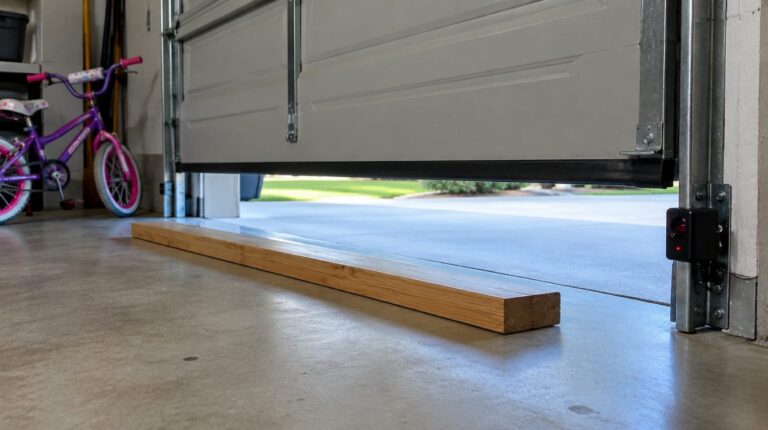
- Check that nothing is sitting in the beam path: a trash can, a bike wheel, a garden hose.
- Gently adjust a sensor that has been bumped until its light goes solid. They’re usually held by a wing nut or a bracket you can loosen by hand.
Our dedicated guide on garage door sensors and blinking lights goes deeper if this doesn’t resolve it.
Key takeaway: Never bypass or disconnect the photo eyes to force the door closed. They’re the system that stops the door from closing on a child or pet.
Step 4: Look for obstructions in the tracks
With the door closed and the opener idle, look along both vertical tracks and up into the horizontal tracks near the ceiling. You’re looking for:
- Debris, rocks, leaves or a toy wedged in the track
- A roller that has popped out of the track
- A dent or bend in the track where something hit it
Debris you can remove by hand. A dented track or a roller out of the track means stop here; forcing the door can pull it fully off track. See our guide on what to do when a garage door comes off track.
Step 5: Try the manual release (carefully)
If the opener runs but the door doesn’t move, or you need to get a car out and the opener is dead, the manual release lets you operate the door by hand. The rule that matters: only pull the red cord when the door is fully closed. If the door is open and a spring has failed, releasing the opener can let the door drop.
With the door closed and the release pulled, lift the door by the handle or bottom edge, keeping your hands clear of the panel seams. What the door tells you when you lift it:
- Lifts easily and stays put: the door is fine; the problem is the opener. Our opener repair service can diagnose it.
- Feels extremely heavy or won’t budge: a spring has likely broken. Don’t keep lifting.
- Lifts crooked or one side drags: likely a cable problem. Stop.
- Drifts up or slams down when you let go: the springs are out of balance and need professional adjustment.
Step 6: Look for visible spring or cable damage
From the floor, with the door closed, look up at the torsion spring above the door (or the extension springs along the tracks on older doors) and at the cables on each side.
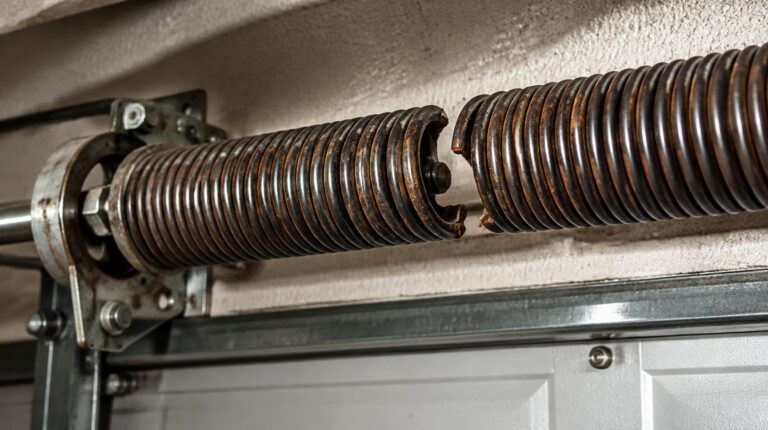
- A torsion spring with a visible gap in the coil is broken. You may also have heard a loud bang earlier.
- A cable that’s hanging loose, frayed, or tangled around the drum has failed.
You’re only looking here. These parts are under enough tension to cause serious injury, and there’s nothing safe for a homeowner to adjust. If you see any of this, go to the “stop and call” list below.
Done with the checks and still stuck? Call 713-598-3837 (Houston) or 281-800-5387 (Clear Lake), or request a free quote.
Stop and call a pro if you see any of these
Everything above is safe. Everything below is not. If you run into any of these, stop using the door, keep people and vehicles out from under it, and call.
- A broken or gapped spring. Spring replacement typically runs $180 to $400 in Houston and is same-day work. It’s never a DIY job.
- A loose, frayed or snapped cable. Cables are attached to the spring system and carry the same tension.
- The door is off track or hanging crooked. The door can fall if it’s moved.
- The door feels very heavy when lifted by hand. That’s a spring problem, and the opener will burn out trying to compensate.
- The opener motor hums or grinds but the door doesn’t move. Usually a stripped gear or a failed motor, which means opening the unit.
Frequently asked questions
How long should I spend troubleshooting before I call?
Ten to fifteen minutes covers everything in this guide. If the door still doesn’t work after that, the fix almost certainly needs tools or parts you don’t have.
Is it safe to keep using the door if it works but makes a new noise?
Usually for a short time, but a new grinding, popping or scraping sound means something is wearing or loose. Have it looked at before it becomes a bigger repair.
What if the door opens but stops partway?
Check for obstructions and photo-eye issues first. If the door stops at the same spot every time and the opener strains, it’s usually a spring or balance issue, which is a stop-and-call item.
Will a technician charge me if it turns out to be something simple?
Most companies, including BBM, charge a service call fee that typically covers the diagnosis. Running through this guide first means that when you do call, you know it’s a real repair and can describe the symptoms, which often means a faster fix.
Related guides
Get same-day garage door repair in Houston
If the checks above didn’t solve it, or you found something on the stop-and-call list, BBM Garage Doors offers same-day and 24/7 emergency service across Houston, Katy, Cypress, Spring, The Woodlands, Pearland, Sugar Land, League City, Clear Lake, Pasadena, Friendswood, Missouri City and Galveston. Call 713-598-3837 (Houston) or 281-800-5387 (Clear Lake), or learn more about our garage door repair services.